Two companies in the same sector adopted AI in the same year. Three years on, they are not in the same business. The first added AI to the organisation it already had - better tools, faster reports, the same structure, the same decision rights, the same speed of learning. It got more efficient. The second became a different kind of organisation: one that senses change earlier, decides faster, learns from every cycle, and adapts before the market forces it to.
The first company optimised. The second company evolved. And in a market that keeps moving, optimising a static organisation is a slow way to fall behind a learning one.
This is the strategic point most AI conversations miss. The prize at the end of AI transformation is not efficiency. It is adaptability. The organisations pulling away are not simply doing the old work faster; they are becoming Adaptive Intelligence Organisations - companies whose operating model is built to sense, learn and adapt as a matter of routine rather than crisis. That is a destination, and like any destination it helps to have a map of how far along the road you are.
The advantage is not intelligence itself. The advantage is the speed at which an organisation turns intelligence into adaptation.
Quick answer
An Adaptive Intelligence Organisation is a company whose operating model has been redesigned to sense, learn, and adapt continuously. It does not just add AI tools to old work. It connects value architecture, workflow redesign, human-AI decision loops, capability building, telemetry, governance, and leadership into one system that can keep improving as the market changes.
The AIO maturity map
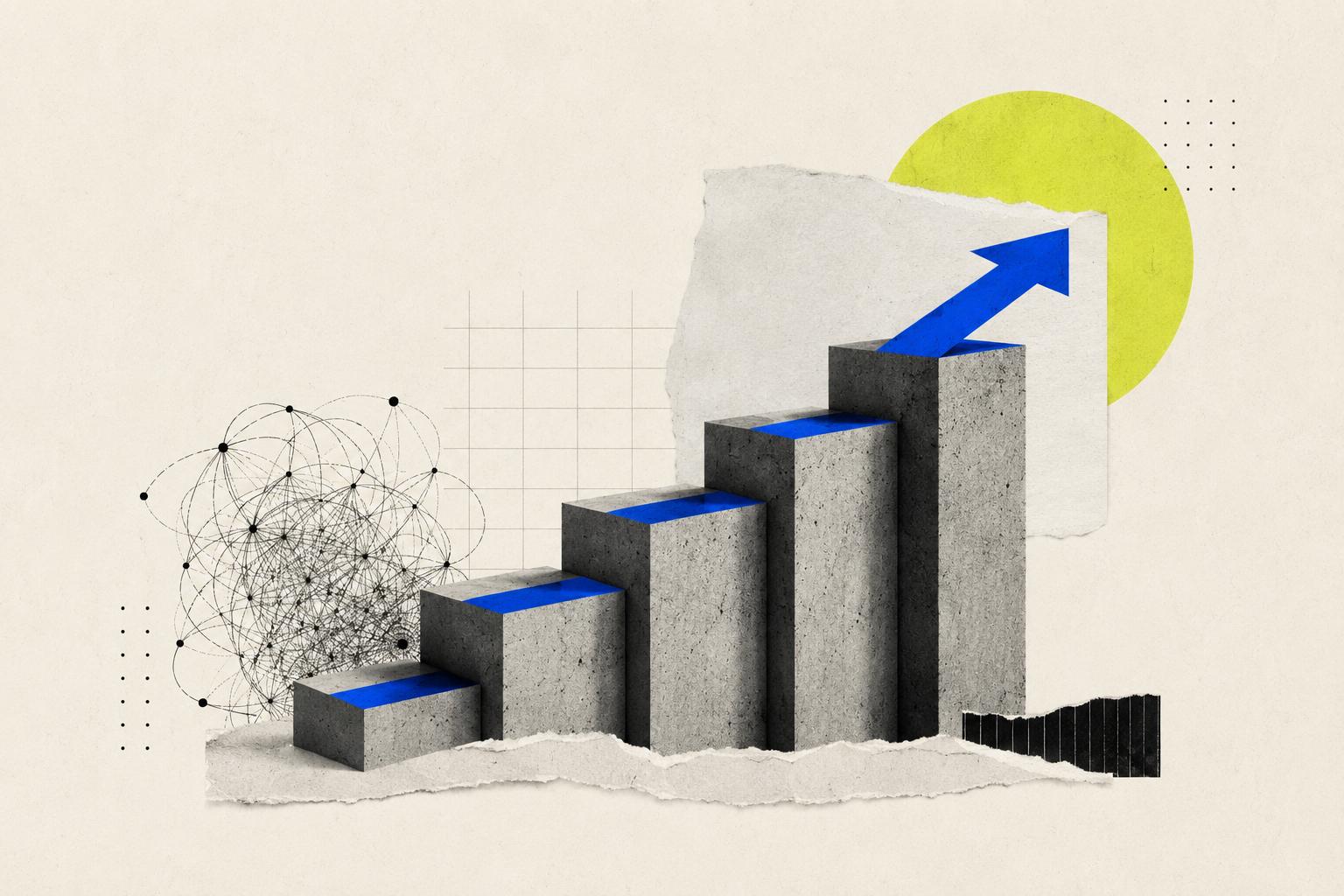
The AIO map has five levels. The ladder is not a promise of guaranteed returns; it is an indicative map of value-capture potential, and its purpose is to tell a leadership team, honestly, where they stand.

Your level is set by the lowest dimension
The single most important rule on that map is also the most uncomfortable. Your level is set by your lowest dimension, not your best initiative.
The AIO Diagnostic reads five of them - Strategy and Value, Leadership and Governance, Work Design, Skills and Talent, and AI Capability Maturity - and an organisation with a brilliant agentic workflow but no governance and no capability plan is not a Level 3 organisation with one weak spot. It is a Foundation-level organisation with one impressive pilot.
This is the chain-dependency rule, and it exists to stop the most common self-deception in AI: scoring yourself by your proudest demo. You cannot outrun your weakest link by sprinting on your strongest.
You do not become adaptive by completing a project.
You become adaptive by operating a system that keeps value, work, people, telemetry, governance, and leadership moving together.
The six disciplines that hold the model together
Becoming adaptive is not a project you complete but a system you operate. The six execution disciplines that run through the AIO model are not a checklist; they are a value stack that only works as a whole.
-
Value Architecture.
Points the organisation at where value lives.
-
Workflow Redesign.
Rebuilds the work around that value.
-
Human-AI Loop Design.
Governs the handoff between human judgment and machine action.
-
Capability Sequencing.
Builds the people who can run the new operating model.
-
Telemetry and Stage-Gates.
Prove what is working and decide what scales.
-
Leadership and Change.
Holds the whole thing together.
Pull any one out and the stack collapses in a predictable way. Value architecture without workflow redesign produces well-chosen initiatives that are badly executed. Redesign without governance produces efficient processes nobody trusts. Governance without capability produces oversight without competence. The disciplines are interdependent by design. That interdependence is the operating model.
What mature AI organisations do differently
The leaders prove the system works as a system. DBS did not reach Level 4 by being strong on one dimension; it built value architecture, redesigned workflows, instrumented telemetry, distributed capability and governed the portfolio together. In 2024, DBS reported SGD 750 million in economic impact from more than 370 AI use cases powered by over 1,500 models.
Moderna's AI adoption shows the same wholeness from another angle: capability democratised across the workforce, but inside a governed environment with the leadership to direct it. Unilever's connected supply chain is not a clever model bolted to an old organisation; it is an organisation redesigned to sense and respond across demand, supply, manufacturing, and distribution.
None of these is a story about a tool. Each is a story about an operating model that turns intelligence into adaptation.
Why the gains compound
There is a deeper logic underneath all of this that leaders should sit with. Progress through the levels is non-linear and the gains compound. The journey from Foundation to Agentic is achievable inside a single engagement cycle; the journey from Agentic to Scaling takes sustained years, because it requires the organisation to learn how to learn.
But every level reached makes the next one cheaper, because adaptive capability - like the value it produces - compounds. The organisation that learns fastest does not just win once. It widens the gap every cycle, which is precisely why the 74/20 value concentration PwC documents keeps widening rather than narrowing.
Three questions for the CEO or board
For a CEO or board deciding how serious to be about AI, the questions are not about tools at all:
If we scored ourselves on the five dimensions honestly, what is our lowest one - and is that, not our best pilot, the true measure of where we stand?
Are we building an operating model that senses, learns and adapts - or are we adding AI to the organisation we already have and calling it transformation?
In a market that keeps moving, is our rate of learning faster or slower than our toughest competitor's - and how would we even know?
The future belongs to the organisation that learns fastest
The Adaptive Intelligence Organisation is not a slogan. It is a specific operating model, with a maturity map, a diagnostic, and six disciplines that work only together. The companies building it are not chasing the next tool. They are building the capacity to absorb whatever the next tool turns out to be.
In the end, the advantage is not intelligence itself - that is becoming abundant and cheap. The advantage is the speed at which an organisation turns intelligence into adaptation.
The future belongs to the organisation that learns fastest.
FAQ
What is an Adaptive Intelligence Organisation?
An Adaptive Intelligence Organisation is a company whose operating model is designed to sense change, learn from every cycle, and adapt continuously. AI is part of the system, but the real shift is organisational: value, workflows, roles, governance, telemetry, and leadership are redesigned together.
What are the five AIO maturity levels?
The five levels are Foundation, Process and Augment, Agentic, Scaling, and Hyperadaptive. They describe how far the organisation has moved from scattered AI activity toward a business model that continuously learns and adapts.
Why does the lowest dimension set the level?
AIO maturity is interdependent. A strong pilot cannot compensate for weak governance, poor capability, unclear value architecture, or unchanged work design. The lowest dimension reveals the constraint that will limit the whole system.
Where should a leadership team start?
Start by locating your current level and identifying the weakest dimension. The AIO Quick Scan gives a fast starting point; the AIO Diagnostic gives a board-ready, five-dimension read of where to act first.
Where do you actually sit on the AIO maturity ladder - and which dimension is holding you back? Start with the free AIO Quick Scan to locate your level, or the AIO Diagnostic for a board-ready, five-dimension read of exactly where to act first. You cannot fix the lowest link until you know which one it is.
Sources: PwC 2026 AI Performance Study; DBS 2024 CIO Statement; OpenAI and Moderna case study; Unilever connected supply chain overview.