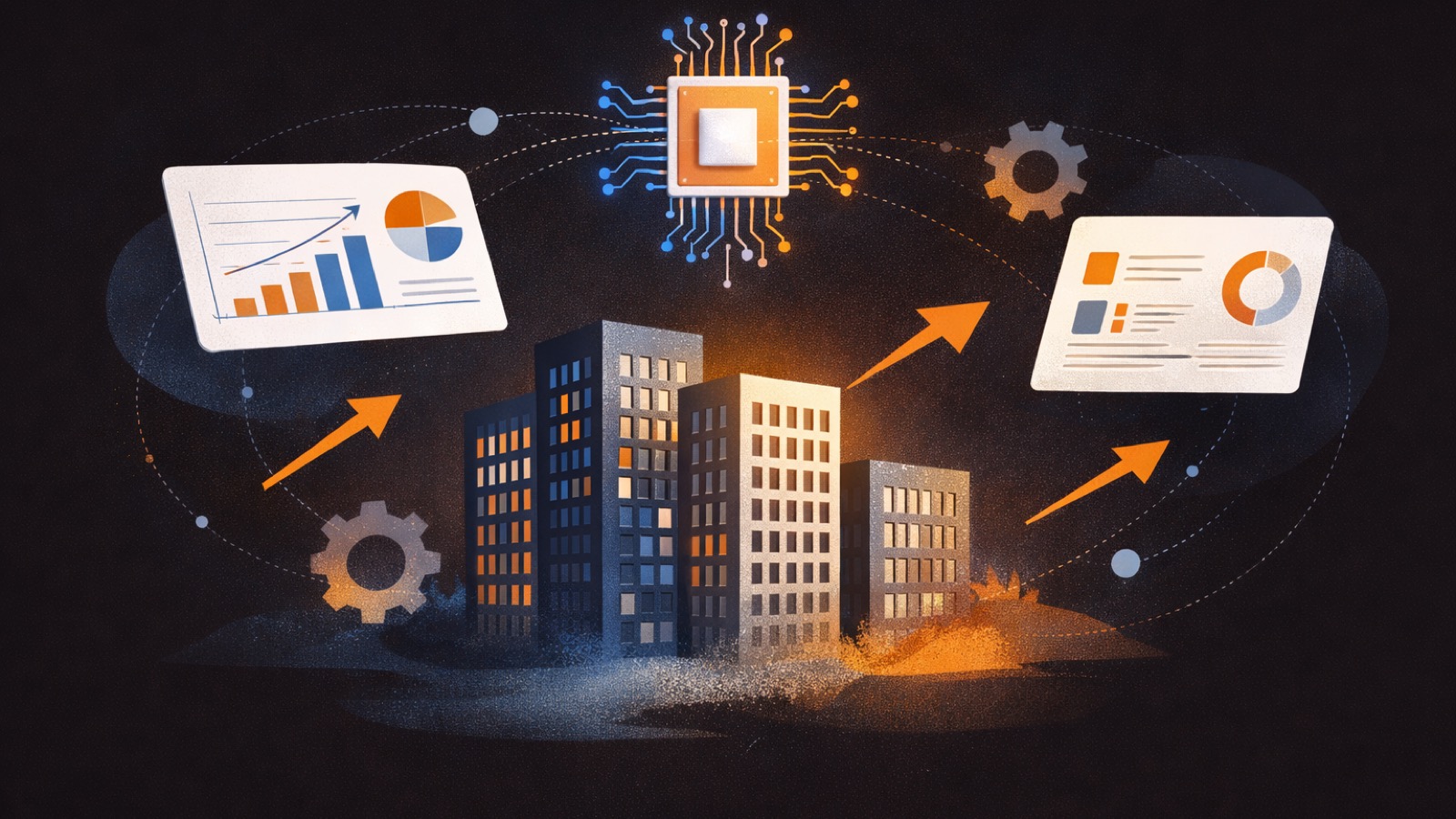
The real question is this: is your organisation designed to create value in a world where intelligence is abundant, affordable, and increasingly autonomous?
That is now the divide. Across every sector, AI adoption is rising fast, but real business value remains concentrated in a small group of organisations. The difference is not access to technology. The models are available to everyone. The tools are getting cheaper. The barrier to experimentation has fallen dramatically.
The new gap is not technical. It is organisational.
What separates leaders from laggards is something deeper: organisational readiness. The firms pulling ahead are not simply adding AI to existing structures. They are redesigning how the business works.
They are reshaping decision-making, workflows, leadership, governance, data, and culture to operate in a very different environment. They are becoming what Green Everest calls intelligence-ready.
This is the paradox of the current moment. Intelligence has never been more available, yet many leadership teams feel less prepared, not more. That is because AI is not just another digital tool. It is a force that exposes weak operating models, fragmented data, unclear decision rights, outdated leadership habits, and cultures that cannot adapt fast enough.
Many organisations still treat AI as a technology programme. They run pilots, appoint task teams, and invest in platforms, but they leave the surrounding business largely unchanged. That approach produces isolated wins, but rarely transformation.
Why? Because the real value is not created by the model alone. It is created by the organisation around it. If workflows stay the same, decision-making stays slow, and managers still operate with old assumptions, then AI delivers only marginal gains. A few hours are saved. Some reports are faster. A few tasks are automated. But the business itself does not become more adaptive, more intelligent, or more competitive.
What an intelligence-ready organisation looks like
An intelligence-ready organisation is not simply AI-enabled. It is deliberately designed to learn faster, adapt faster, and create value faster because it can combine human judgment with machine intelligence in a disciplined way.
It knows where AI should act
- It is clear about which decisions can be automated and which still need human judgment.
- It treats autonomy as a design choice, not an accidental side effect.
It knows what data matters
- Its intelligence infrastructure is usable, trusted, secure, and tied directly to business decisions.
- It does not allow fragmented data to amplify confusion.
It knows how to govern change
- It governs risk, oversight, and accountability as work changes.
- It keeps people engaged while new ways of working are introduced.
Six shifts matter most
In practical terms, six shifts define whether a firm becomes intelligence-ready or stays stuck in pilot mode.
What this means for leadership
The leadership challenge is no longer only execution. It is orchestration: setting boundaries, designing oversight, interpreting outputs critically, managing risk, and deciding where human judgment matters most.
What boards should be asking now
For boards and executive teams, the question is no longer just whether the company has an AI strategy. The better question is whether the organisation is becoming capable of creating sustained value from intelligence.
Business design questions
- Which workflows have actually been redesigned?
- Where are we seeing measurable business value?
- What proprietary data is strengthening our position?
Governance questions
- How are we governing autonomy and accountability?
- Are our people ready for the way work is changing?
- How fast can we learn and adapt compared to the market?
The Green Everest view
At Green Everest, we believe the next winners will not be defined by AI adoption alone. They will be defined by whether they redesign the firm around intelligence.
That means strategy, design, leadership, operating model, governance, data, and culture must move together - not as isolated workstreams, but as one business transformation. Because that is where the real value sits: not in the model, not in the software, not in the pilot, but in the redesign.
The future will not belong to organisations that simply install AI. It will belong to organisations that become more adaptive, more intelligent, and more human in how they use it.
The winners will be those that can learn while they operate, evolve while they grow, and redesign themselves before disruption forces them to. That is the next frontier of competitive advantage: not just AI-enabled, but intelligence-ready.