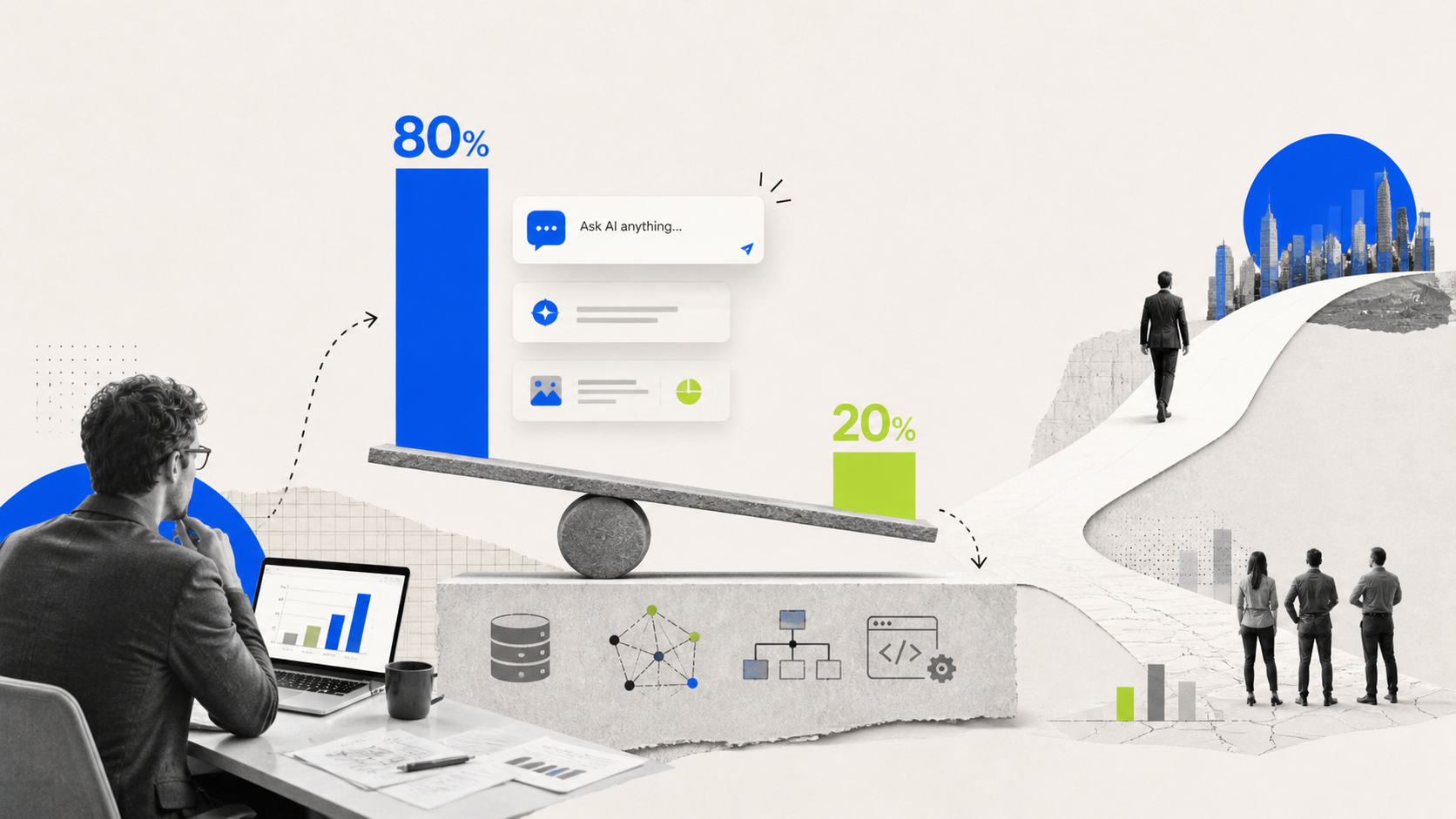
In April 2026, PwC published the largest empirical study ever conducted on AI performance. They surveyed 1,217 senior executives across 25 sectors. They asked one core question: what is the actual financial return your company is getting from AI right now?
The answer was uncomfortable.
Three-quarters of the economic value AI is creating is being captured by just one-fifth of organisations. The leaders are generating 7.2 times more AI-driven gains than the average competitor. And the gap is widening - not narrowing.
That finding is not really about technology. The leaders are not using fundamentally different AI than the laggards. They are not buying secret models. The largest enterprise AI vendors sell to both groups. ChatGPT works the same in every company.
What the leaders do differently is they redesigned the work.
Quick answer
The 80/20 trap is the habit of spending most AI energy on tools, models, licenses, and pilots while underinvesting in the work redesign that produces most of the value. AI leaders do not simply add AI to old workflows. They decompose work into tasks, decide what should be automated or augmented, govern the risk, and rebuild the process around human-AI collaboration.
The 80/20 rule of AI value
PwC's 2026 AI Predictions piece states it cleanly: technology delivers about 20% of an AI initiative's value. The other 80% comes from redesigning work - so AI handles routine cognitive load and people focus on what genuinely creates impact.
Most organisations are doing the opposite. They are investing heavily in the 20% - tools, models, API access, license seats - and starving the 80%. New chatbot, same broken support process. New code copilot, same brittle deployment pipeline. New AI summarisation tool, same hand-cranked board pack.
What the leaders actually do differently
Compared with everyone else, the AI leaders in PwC's data are:
MIT Sloan's research arrives at the same conclusion through a different door. Visiting senior lecturer Paul McDonagh-Smith describes the core mistake bluntly: too many organisations are thinking of AI as a toolkit, when they should be seeing AI as an operating system.
The most important methodological move is also the simplest. The unit of redesign is not the job. It is the task.
When you decompose a role into its constituent tasks - typically 15 to 40 of them - you can ask, for each one: should this be automated, augmented, or kept human-led? That question is impossible to ask at the level of "the marketing manager" or "the support agent." It only becomes answerable at the level of the task.
The five levels - and where the line is
Most AI maturity models are abstract. The one PwC's data implies is concrete enough to act on:
-
Level 1 - Thought partner.
People ask AI things. The work is unchanged.
-
Level 2 - Contextual assistant.
AI is embedded in a tool. People still drive.
-
Level 3 - Configured agent.
AI agents execute bounded workflows with guardrails.
-
Level 4 - Redesigned process.
End-to-end workflows are rebuilt around what AI does best.
-
Level 5 - AI-native.
AI is the default operating system for core work.
The PwC data shows the discontinuity clearly: the leader-versus-laggard line opens between Level 3 and Level 4. That is the moment a company stops treating AI as something added to a workflow and starts treating the workflow as something to be designed around AI.
The SME advantage nobody talks about
There is a counter-intuitive truth tucked inside this data. Smaller companies have a structural advantage in this race.
Large enterprises have legacy processes that took 30 years to encrust. Each redesign requires unwinding a decade of system integrations, change-management committees, and political ownership of "the way we do things." The cost of redesigning a single workflow can run into the millions.
A 200-person SME usually has none of that. The general manager and the operations lead can sit in one room and rebuild the customer onboarding process in two weeks. The decision rights are short. The systems are simpler. The legacy is lighter.
What SMEs typically lack is methodology. They do not redesign because they do not know how. The leaders, large or small, share one trait: they have a repeatable way of doing this.
The six moves that work
The methodology is not complicated. Six steps:
-
Diagnose.
Quick scan your current state. Pick one workflow.
-
Decompose.
Map the workflow into tasks. Classify each as automate, augment, or human.
-
Co-design.
Bring the people who do the work into the room. MIT Sloan's research is unambiguous on this - exclusion at the design phase causes failure at the scale phase.
-
Build.
Run a four-to-eight-week pilot. Instrument it before you launch it.
-
Govern.
Wrap the workflow in Responsible AI and decision-tier guardrails before scaling.
-
Scale and learn.
Replicate the pattern. Treat AI use cases as a portfolio you actively manage.
What makes this work is the order. Most failed AI deployments invert it. They build first, then govern, then realise they should have decomposed and co-designed.
The window is closing
PwC's data has one more uncomfortable implication. The 20% of companies pulling ahead are not slowing down. They are building organisational muscle in this work-redesign discipline that compounds with every cycle. The third workflow they redesign is faster than the first. The fifth is faster than the third.
Meanwhile, the companies still running disconnected pilots are accumulating a different kind of compounding - technical debt, scattered governance, frustrated users, unclear ROI.
A year from now, the gap PwC measured will be wider, not narrower. By 2027 it will become structural. Catching up will not be a matter of buying more AI. It will require what the laggards are still avoiding now: the slow, deliberate, frontline-led work of redesigning how the company actually does work.
The question is not whether your company is using AI.
The question is whether your company is changing because of it.
FAQ
What is the 80/20 trap in AI?
The 80/20 trap is spending most of the budget and leadership attention on the technology layer while neglecting the workflow redesign, governance, measurement, and capability building that produce most AI value.
Why do AI pilots fail to produce ROI?
AI pilots usually stall when they automate fragments of old work instead of redesigning the full workflow. The model may work, but the operating model around it does not change.
Where should an SME start?
Start with one workflow. Diagnose the current state, decompose the work into tasks, choose what AI should automate or augment, involve the people closest to the work, and govern the pilot before scaling.
Sources: PwC 2026 AI Performance Study; PwC 2026 AI Predictions; MIT Sloan on accelerating AI transformation; MIT Sloan AI Work Redesign Playbook; BCG, "AI Will Reshape More Jobs Than It Replaces"; World Economic Forum, "AI at Work".